Complex Systems
I conceived Complex Systems as four interconnected phases. The project has two strands: a pilot that has tested the process at a smaller scale and a planned full programme that can develop it further.
Strand 1 — The Pilot
The pilot making and installation took place at Park Community School in August 2026. The pilot ring sheet contained 35 rings. Observation is still underway and is planned to continue through January 2027. The pilot follows four phases:
- Phase 1 — Preparing the System: harvesting willow, bringing participants together and making individual rings.
- Phase 2 — Building the Ring Sheet: weaving the rings together into a connected sheet.
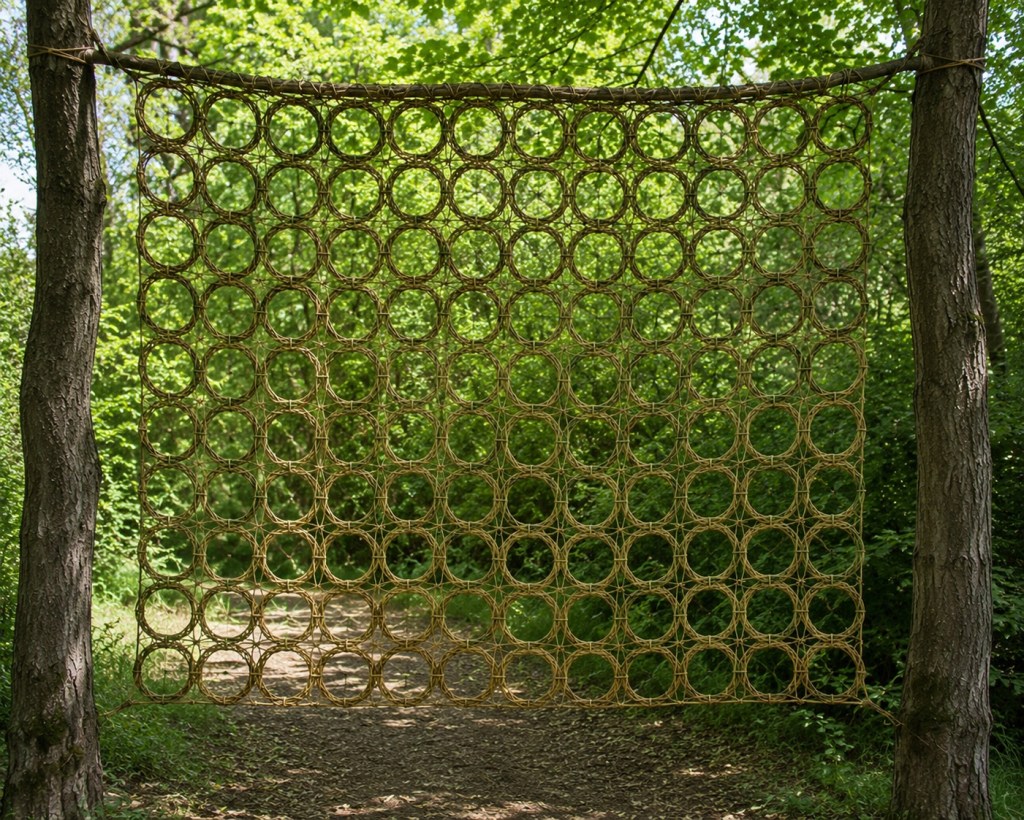
- Phase 3 — Public Sculpture: installing the pilot ring sheet as a hanging curtain.
- Phase 4 — Observation and Change: durational systems observation, documenting how weather, time and interaction transform the work.
Strand 2 — The Full Programme
The full programme is planned as a larger participatory project, developed with a future partner and adapted to its setting, available materials and participants. It will follow four interconnected phases:
- Phase 1 — Preparing the System: gathering volunteers and participants, harvesting and preparing materials and making individual rings.
- Phase 2 — Building Complexity: connecting the rings into a larger ring sheet and exploring the sculptural forms it can take.
- Phase 3 — Public Sculpture: developing a sculptural form from the ring sheet and installing it in a public setting.
- Phase 4 — Observation and Change: observing and documenting how the sculpture behaves and transforms over time.
The Project
Complex Systems is a participatory public artwork exploring how complex forms emerge from simple individual actions. Rather than beginning with a predetermined sculpture, the project starts with a single woven ‘ring’ unit.
Each participant contributes one willow ring, creating an individual element within a much larger system. As these rings accumulate and become interconnected, new patterns, structures and sculptural possibilities emerge that could never be predicted from the individual components alone.
The artwork asks participants to experience complexity through making. By contributing a single action to a collective process, each person becomes part of an artwork whose final form is shaped through collaboration, emergence and the relationships between its many interconnected parts.
Complex Systems can be developed in partnership with a school, community group, organisation or host site. It offers opportunities for volunteer participation and shared making, using locally available natural materials where appropriate. SculthorpeStudios is seeking partners to develop the full programme. Please reach out on SculthorpeStudios@gmail.com to chat about your ideas.
The Ring Sheet
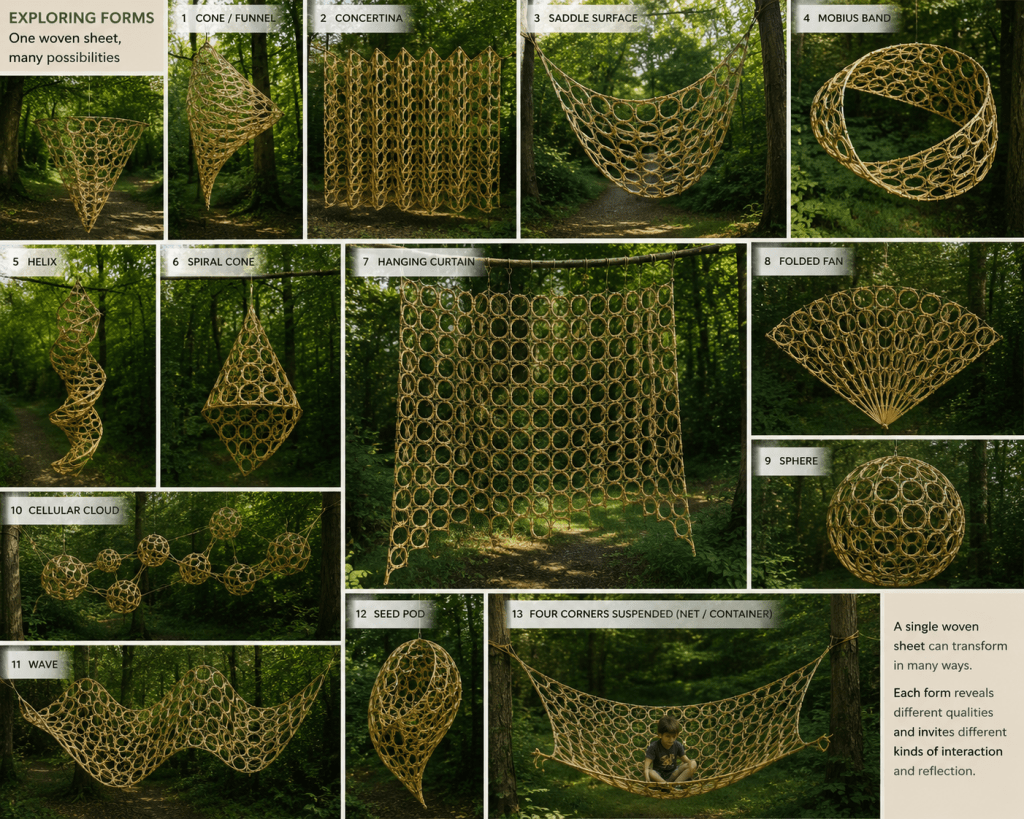
The 35-ring pilot ring sheet allowed the project to test making, assembly, installation and observation at a smaller scale. Its limited size was insufficient for full exploration and manipulation into other sculptural forms. The full programme therefore requires a ring sheet of at least 150 rings, providing the scale needed to explore different forms through folding, suspension, draping and tension.
Ideas for Full Programme Sculptures
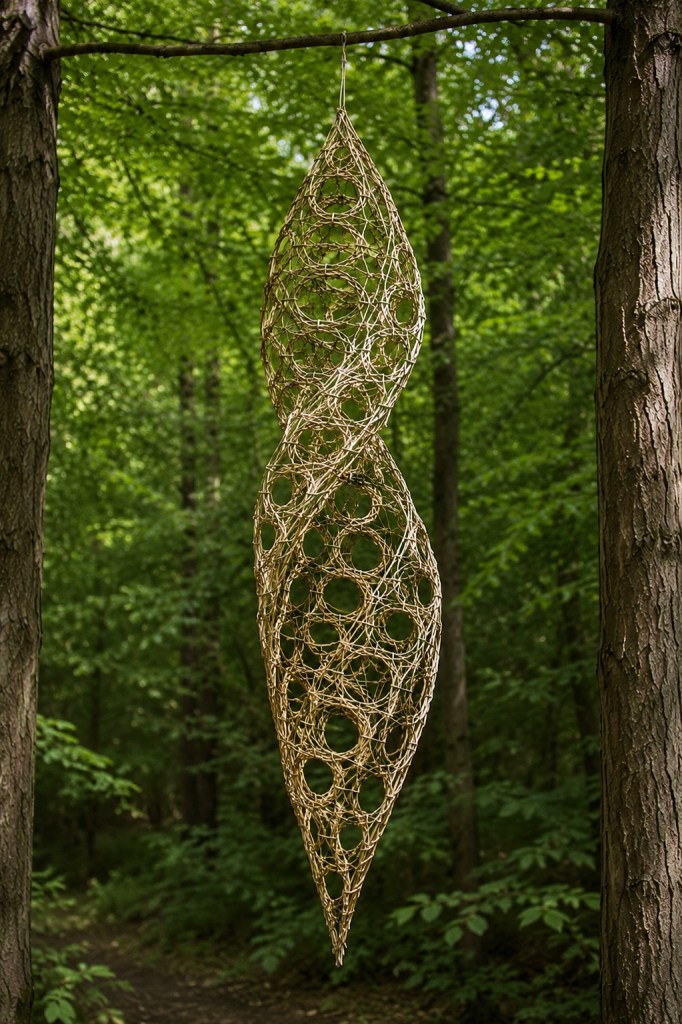
These concept images explore how the larger ring sheet could be manipulated into different sculptural forms in the full programme. They are ideas for future development and were not realised as part of the pilot.
Systems Concepts
One ring does not represent a person…but an element.
The moment four rings are woven together a new property appears – the diamond. The diamond is not made by any one ring; it’s a property of the relationship between rings.
As the sheet grows, it begins to represent several systems concepts simultaneously:
- Emergence
- Interdependence
- Structural constraint
- Resilience
- Flexibility
- Local actions producing global form
What is Represented?
Relationships and system behaviour. Not people or landscapes, nor narratives.
Each ring represents an individual element or autonomous agent or a node.
The Ring Sheet represents emergence, relationships, structural dependence and collective behaviour.
Who is Represented?
Every participant occupies an equivalent structural role, contributing locally to a globally emergent structure.
This is a shift away from identity towards participation within a network.
Whose identity is shown?
This work reframes identity to ask: What happens to my sense of identity when I realise I am simultaneously an individual element and part of a larger interconnected whole?
Who controls meaning?
Meaning emerges through the interaction of participants, artwork and observer.
No single participant controls the meaning. Meaning emerges from the dynamics of the whole system.
What my artwork seeks to ask
This artwork builds on my inquiry: how do people change through participation in an embodied system?
My artwork seeks to represent systems and create systems of participation.
Can it also activate systems thinking in participants?
My artwork does not seek to symbolise a character of the system, like emergence; it seeks to behave emergently.
The Ring Sheet acquires properties that no single ring possesses. A painting of a flock of birds represents emergence, but the Ring Sheet enacts emergence through its material structure.
My sculptural work does not simply depict systems; the artwork embodies and enacts system principles through its material properties and through participation.
Explore the wider studio approach in How I Work and Systems Practice. To discuss a future partnership, contact SculthorpeStudios.

