Tracing Systems – Making the Vine Torus Armatures
Tracing Systems – Phase 2: Describing Systems with Torus Sculptures
The torus sculptures developed through Tracing Systems are not symbolic representations of organisations, but physical records of navigating them.
In 2026, Dawn Sculthorpe-Hayter began an auto-theoretical inquiry into the organisational systems required to realise an ephemeral public artwork. Rather than documenting meetings, permissions, negotiations and correspondence through text alone, these experiences were translated into sculptural form. Each torus records a distinct organisational system encountered during the project, capturing how that system was experienced through the process of making.
The physical characteristics of each torus—including its weave, height, depth and diameter—emerged from repeated interactions within that organisational system. Meetings, permissions, negotiations, compromises and moments of progress or constraint were translated into material decisions during construction. Together, the seven toruses describe the network of organisational systems that made the artwork possible. They provide a means of representing relationships, processes and lived experience through sculptural form, demonstrating how complex organisational activity can be observed, interpreted and communicated beyond conventional written documentation.
While each torus represents a distinct organisational system, they were never intended to remain isolated objects. The installation brought the seven forms together as interacting components within a new environmental system. Suspended from a single beam and exposed to wind, rain, sunlight, gravity, wildlife and human interaction, the toruses became interdependent through their ongoing relationships with one another and with the landscape. Their movements, contacts and gradual transformations could no longer be understood as properties of individual sculptures alone, but as behaviours emerging from the system they collectively formed.
This shift reflects a fundamental principle of systems thinking: when previously independent elements become connected, new behaviours and properties can emerge that are not present in the individual parts. Over time, weathering, biological activity, material degradation, human engagement and changing environmental conditions continuously reshaped the installation. Rather than resisting these influences, Tracing Systems embraced adaptation, emergence, feedback and impermanence as essential characteristics of a living, ephemeral artwork. The installation therefore became both a representation of organisational systems and an ongoing experiment in how interconnected systems evolve through continual interaction with each other and their environment.
The construction method described below explains how each torus is physically produced. It forms one stage within a broader construction system that includes material harvesting and preparation, armature construction, sculptural consolidation and final installation. While the method can be replicated technically, the dimensions and structure of each completed torus remain specific to the organisational system and experiences from which it emerged.
This method documents the construction of the initial armature structure. It demonstrates how to develop structurally stable armatures on site within a vineyard.
Further material is required to develop the torus into a fully consolidated sculptural form.
This method has been developed during Tracing Systems with primary material preparation undertaken at Ashling Park Vineyard in West Sussex, UK.
Method Overview
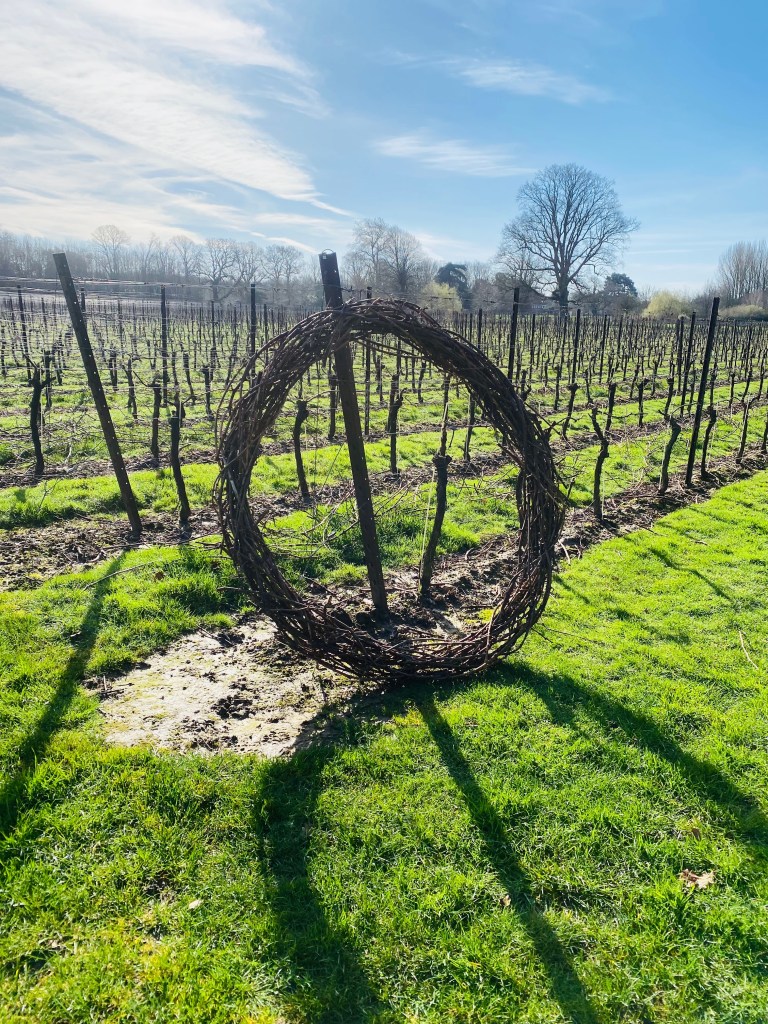
The torus is constructed through continuous bending, wrapping and compression of vine lengths into a rope length, then horseshoe, then circular form.
Stability is achieved through density and tension rather than fixed joints or internal armature.
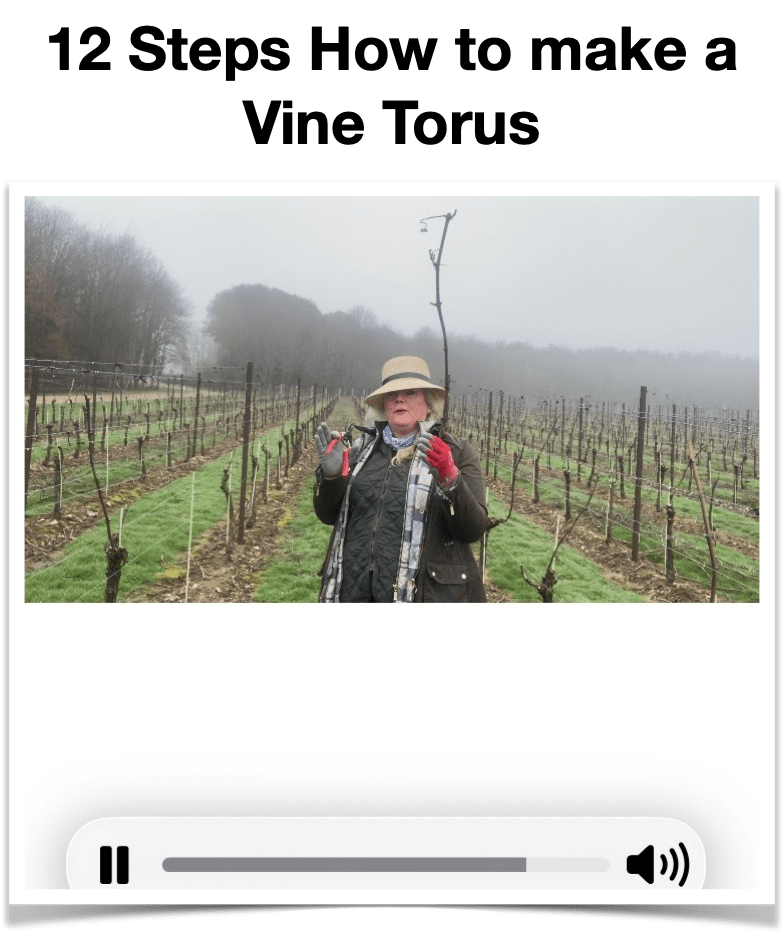
Basic Steps
- Select long, flexible vines
- Prune all dead or broken branches – leaving some hooks
- Prepare piles of prepared vines
- Work through the piles making long ropes of entwined vines
- Produce a rope long enough for the required circumference
- Hold shape through hand tension, work the vines in concert with their natural shape
- Allow bend in the rope to form a natural horse shoe
- Secure the torus/circle shape by joining the ends of the horseshoe
- Begin wrapping additional vines around the circle
- Build thickness evenly across the form
- Rotate the structure as you work
- Add shorter lengths to reinforce weak points
- Compress and tighten the weave
- Adjust shape to maintain circular consistency
- Continue until the structure holds independently
- Lift, roll and test integrity
- Refine as needed
Materials
- Fresh (up to 3 months on damp ground) vine clippings greater than 40cm in length
- Pruning saccateurs
- Gloves
Working Conditions.
- Approx. 3 hours: vine preparation
- Approx. 2 hours: initial armature formation
- Approx. 1 hour: structural consolidation
Total time per torus: ~6 hours
Requires stamina and sustained manual handling.
Project Context
System design: Dawn Sculthorpe
Location: Ashling Park Winery
Project: Tracing Systems (2026)
Method Extensions (in development)
This armature method forms part of a broader construction system currently under development:
- Material Harvesting and Preparation
- Armature Construction (this method)
- Sculptural Consolidation (Phase 3)
- Installation Systems (ground, suspended, vertical)
 SculthorpeStudios